Table of Contents:
How does contactless NFC technology actually work?
To understand contactless payments, it helps to start with the NFC meaning. But what is NFC short for? NFC stands for Near Field Communication. When asking what does NFC mean in practice, it refers to a short-range wireless connection that allows devices to exchange small amounts of data.
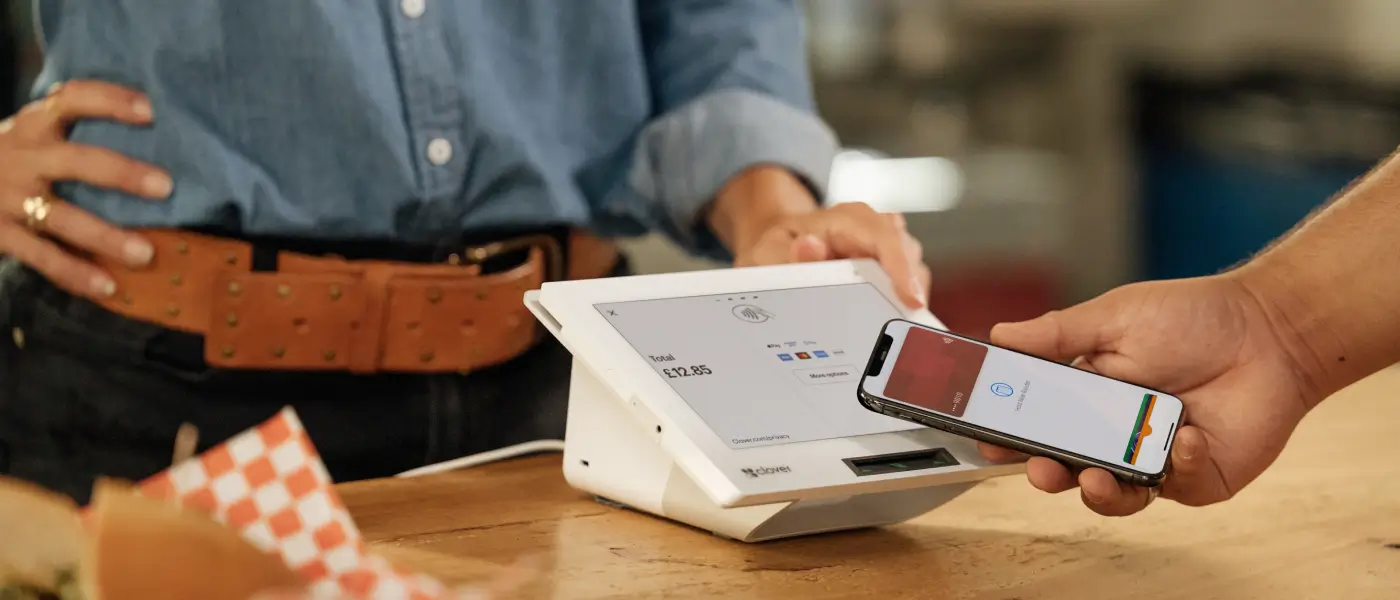
So, what is NFC at the checkout? Contactless NFC creates a secure link between an active device, such as a Clover Flex or Clover Mini, and a passive device, such as a debit card or smartphone. The connection works only within a range of around 4cm.
This answers a common question: how does NFC work so quickly? The Clover terminal generates a radio field. When a card enters that field, the NFC chip activates instantly and sends encrypted payment data. This rapid exchange explains the ‘tap to pay’ experience.
Unlike Bluetooth or Wi-Fi, NFC requires close physical proximity. That design forms a built-in safety feature for any NFC card payment. A brief tap completes the transaction and the connection closes immediately.
And what is an NFC tag in everyday payments? When businesses ask what is an NFC tag, the simplest explanation involves a tiny chip and antenna embedded in cards, phones or wearables. In payments, the NFC tag stores secure data that communicates with the POS terminal. This same principle applies to loyalty cards, access passes and smart posters used across retail and hospitality.
Why the security of ‘Tap to Pay’ is superior to traditional methods
Security forms a core part of the NFC meaning. Contactless NFC uses tokenisation. During an NFC card payment, real card details stay hidden. Instead, a one-time encrypted token completes the transaction. That token becomes useless after use. This model explains how does NFC work securely at scale.
Older swipe methods relied on static card data, which increased exposure to skimming. Contactless NFC removes that weakness. Clover point-of-sale systems meet PCI DSS standards, protecting both merchants and consumers during every transaction.
Accepting an NFC card payment on Clover POS
Clover hardware includes integrated NFC readers as standard. Devices such as Clover Flex, Clover Mini and Clover Station Duo accept contactless NFC without external equipment. This design simplifies checkout. Staff present the terminal, the customer taps and the payment completes.
Mobile wallets such as Apple Pay and Google Pay use the same NFC protocols, which allows businesses to serve cashless customers using one unified system. Clover POS solutions also combine payments with inventory control, employee management and integrations with accounting and eCommerce tools.
The key benefits of contactless NFC for UK businesses
The UK contactless spending limit remains £100 per transaction, as confirmed by the Financial Conduct Authority in the Engagement Paper on Contactless Payment Limits.2 Yet, according to the Office for National Statistics, card payments now dominate UK retail spending, reflecting sustained growth in contactless usage. 1
Contactless NFC speeds up transactions, delivering measurable efficiency gains. Faster payment processing reduces queue times during peak periods, especially in high-footfall locations such as popular cafés or transport hubs. This efficiency matters in high-traffic environments such as pubs, restaurants and retail stores. Adopting NFC card payment technology also supports brand perception. Businesses using modern payment systems appear efficient, secure and customer-focused.
Conclusion: Future-proofing business operations with Clover NFC
Contactless NFC now represents a baseline expectation rather than a premium feature. The NFC meaning extends beyond convenience to encompass security, speed and scalability.
By adopting Clover’s all-in-one POS systems, businesses access more than payment acceptance. They gain tools for stock control, staff management and digital reporting, all built around secure NFC card payment technology.
As ‘tap to pay’ adoption continues, contactless NFC forms the foundation for innovations such as digital loyalty schemes and integrated eCommerce. Businesses that invest early remain positioned for long-term growth. Contact us today for more information on accepting contactless NFC payments.
Bibliorgraphy
1 Office for National Statistics: Retail industry
2 Financial Conduct Authority: Contactless Payment Limits